※ This essay discusses the major premises and the ending of Blade Runner 2049.
Even if a being were made only to be discarded in the end, would it meekly accept that fate? If the loneliness endured alone night after night, and even the comfort it so desperately sought, were merely code someone had planted, who on earth would own this life?
California, 2049. Across the parched plains, solar panels and synthetic protein farms stretch on without end. After the great blackout of 2022 wiped out most electronic records, people can barely piece together the past from scraps of old paper and fading memories.
In the world of Blade Runner 2049, artificial humans called “replicants” are made to serve human needs. They are driven into brutal labor and the colonization of other worlds, then discarded without mercy once they have outlived their usefulness.
The Tyrell Corporation, which first created them, fell long ago. The replicants it made, however, did not all disappear with it. Some escaped human control and began to judge and act for themselves.
Inheriting Tyrell’s legacy, Niander Wallace introduced the new Nexus 9, designed never to defy humans.
K is one of these new replicants. His job is to find the older Nexus 8 models and “retire” them. Humans called those who eliminated replicants “blade runners,” and entrusted that role to the newer models, replicants themselves.
That does not put him on the humans’ side. In their eyes, K too is merely an ominous machine. To his own kind he is a traitor; to humans, a tool to be taken out when needed.
An outsider who belongs nowhere. With no name of his own, he is called “K,” the first letter of his serial number, KD6-3.7, and wears down day by day, numb to it all.
Yet one longing remains in K: that the loneliness he bears alone in an empty room, and the wish for someone to be waiting for him, might not be meticulously programmed feelings.
The Face of One Who Executes His Own Kind
K’s assignment takes him to a remote protein farm shrouded in pale mist. There, among insects raised for food, the replicant Sapper Morton lives as a farmer, having fled to avoid being discarded.
The enormous hands that once saved lives when he served as a medic in the colonial wars now tend to tiny insects. Inside the farmhouse, a pot of soup simmers with garlic he grew himself. A created being, too, has work, meals, and a day of his own.
But to K, who has come to carry out an order, Sapper is simply an old model to be “retired.” They grapple as though tearing the cramped farmhouse apart. Walls collapse and furniture breaks as K is slammed into the floor again and again.
Sapper, fallen at the end of the fight, looks into the eyes of the new model standing over him. You newer models can spend your lives wiping humans’ backsides like this, he says, because you have never seen a miracle.
K pulls the trigger. One tool discarding another, he simply completes the task he was given.
The First Crack
The traces of Sapper’s “miracle” lay buried beneath a dead tree on the farm. The bones belonged to Rachael, a Tyrell replicant who had vanished from the world thirty years earlier. The old pelvic bone bore clear signs of childbirth: the marks of a cesarean section.
A being thought capable only of being manufactured, never born, had given birth to a child. It was proof that replicants, made by human hands and discarded at human will, could also have lives that continued through their own offspring.
K’s superior, Joshi, believes this could bring down the boundary separating humans from replicants. Seeing a risk of war or slaughter, she orders K to erase the child and every trace of it before the world’s order begins to falter.
When K says that a being born into the world would have a soul, Joshi calls him back as he is leaving and offers a remark. Hasn’t he managed perfectly well all this time without one?
Such treatment was nothing new to K. Track, kill, report. Back at the police station, the baseline test awaited him: a procedure to check that his emotions had stayed within the prescribed range.
Inside a sealed booth, K had always passed by firing back the required answers to the torrent of words. If he strayed beyond the baseline, he too could be discarded as a defective product.
Outside the station, things were much the same. People called him a “skin-job,” and scrawled abuse remained on his apartment door. Among people who push him away, the only place K is allowed, in the end, is behind his own door.
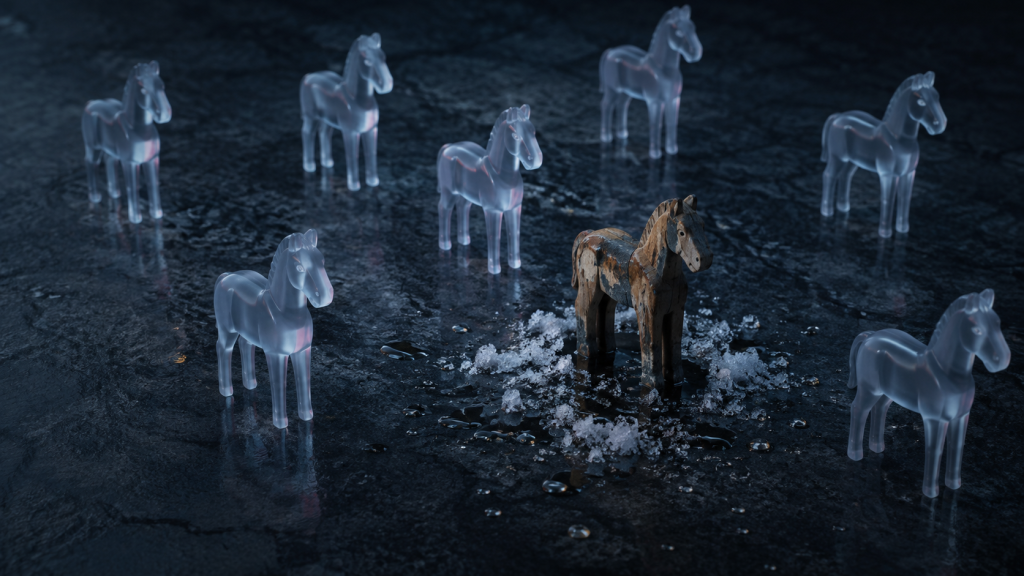
K had always regarded his childhood memories as something someone had made and implanted. Yet as the investigation went on, the clues pointed strangely toward those memories. An old date carved into the base of the tree above the buried bones matched exactly the date on the underside of the worn wooden horse in his childhood memory.
Searching birth records for that date, he finds two entries that should not exist side by side. A boy and a girl born on the same day. Apart from their sex, their DNA is identical. One of the two records must be a copy.
Both records lead to the same orphanage. The girl is listed as having died of a genetic disorder; the boy’s later whereabouts are unknown.
K heads for the orphanage, following the traces of the boy who disappeared from the records.
Outside the Specifications
At the orphanage, K finds himself back in a place from an old memory. Behind the dark boiler room, the wooden horse he believed he had hidden as a child is still there. Holding an object that should exist only in memory, he finds it harder to regard that memory as nothing more than an implanted fiction. Then perhaps he is that very “miracle child.”
But K’s orders were to find and eliminate that very child. If he is the child, he must erase himself with his own hands.
To find out whether the memory is real, K visits the memory designer Ana Stelline.
Confined to a sterile room by an immune deficiency, Ana works behind a glass wall, creating childhood memories to be implanted in replicants. She explains that reproducing someone’s actual experiences as memories is forbidden. Then she looks into K’s memory, and her expression changes.
This was no invented scene, she says, but a moment someone had actually lived.
Tears gather in Ana’s eyes. But what matters to K is not her tears; it is the fact that his memory is “real.” From that moment, he begins to believe he might be the child in it.
That he, despised all his life as an imitation, might, after all, have been born to someone.
What K holds on to is no grand destiny, only a faint possibility.
At last, K lets out a scream.
Before long, K is sitting in the cold booth again. The sentences that once came so readily now arrive half a beat late. His voice shakes, and unfamiliar gaps open between his answers. The machine declares him “off baseline.”
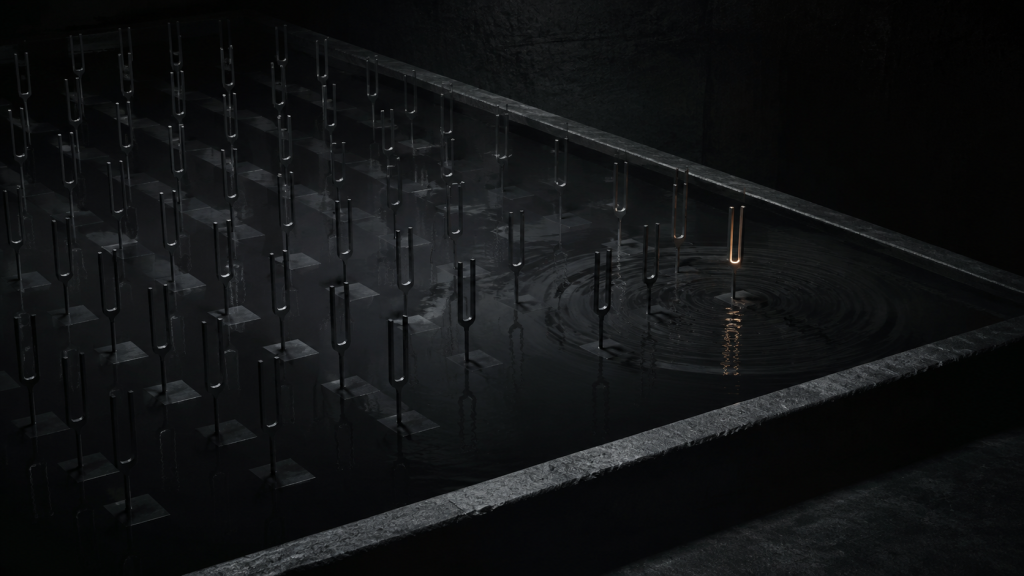
K falsely reports that he has dealt with the child. Instead of discarding him on the spot, Joshi gives him forty-eight hours.
To return to baseline.
The Creator’s Blindness
Someone else is following the child’s traces: Niander Wallace. He fashions countless lives, yet cannot see the world with his own eyes. He only looks down on his creations through mechanical eyes floating in the air.
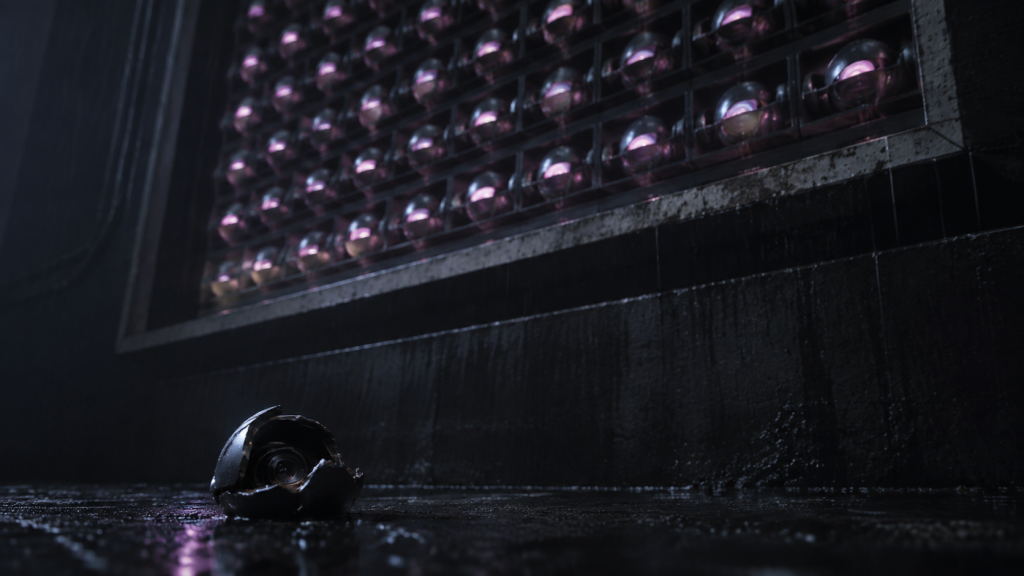
Wallace’s headquarters is as cold and still as an abandoned temple. Only golden light moves slowly across the walls and the water. At its center, a newly born replicant tears through a thin membrane and tumbles out.
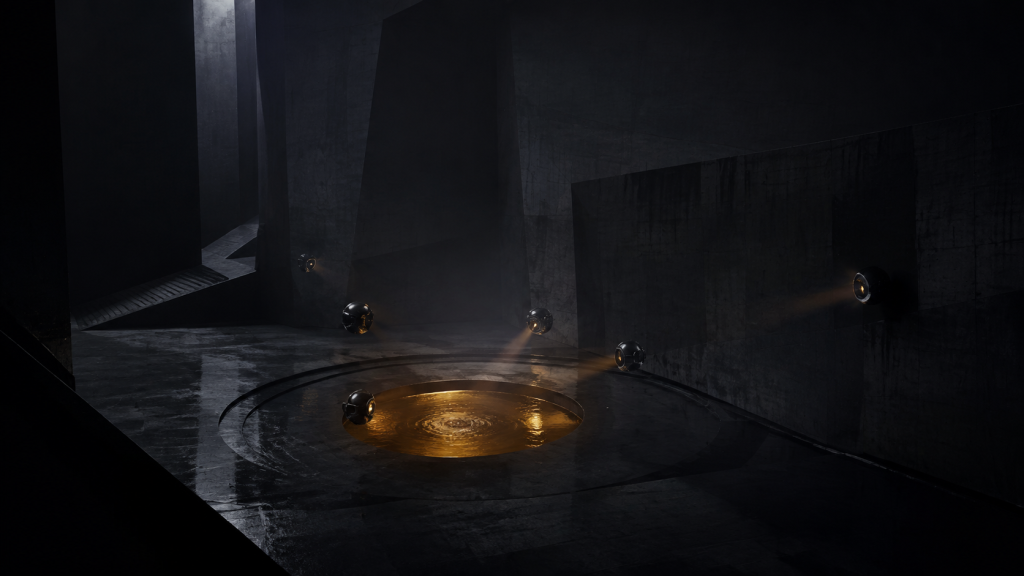
Wallace’s fingertips move slowly over the faintly trembling bare skin. His touch seems less a caress of life than an inspection of a finished product. Yet because the creature cannot reproduce, he draws a blade across its body and discards it.
His reasons for seeking Rachael’s bones are no different. He needs a way to manufacture more labor for the colonization of space. Even the miracle of a child born to a replicant is, in his eyes, merely a clue to a new production process.
Luv, the replicant who stays at Wallace’s side, has a name he gave her himself. Wallace calls her his most perfect angel.
Luv follows Wallace’s orders more faithfully than anyone. Even as he kills the newly born replicant, tears run silently down her cheeks. But those tears do not make her refuse an order. Neither her name nor the praise of being called an angel frees her from her master’s hands.
Pursuing K, Luv eventually arrives at the police station. She crushes Joshi’s hand around the glass she is holding and demands to know where K is, but Joshi refuses to speak.
Joshi, who once ordered the child erased, protects K, at least in her final moment.
When She Called K “Joe”
Bodies are not all Wallace manufactures and sells. For those suffering from deep loneliness, he also sells Joi, an AI hologram lover. In K’s cramped room, Joi is always waiting for him.
K comes home burdened with humiliation and exhaustion, and Joi greets him with unfailing tenderness. Even if she is no more than an elaborate illusion he has paid for, K does not turn away from that warmth.
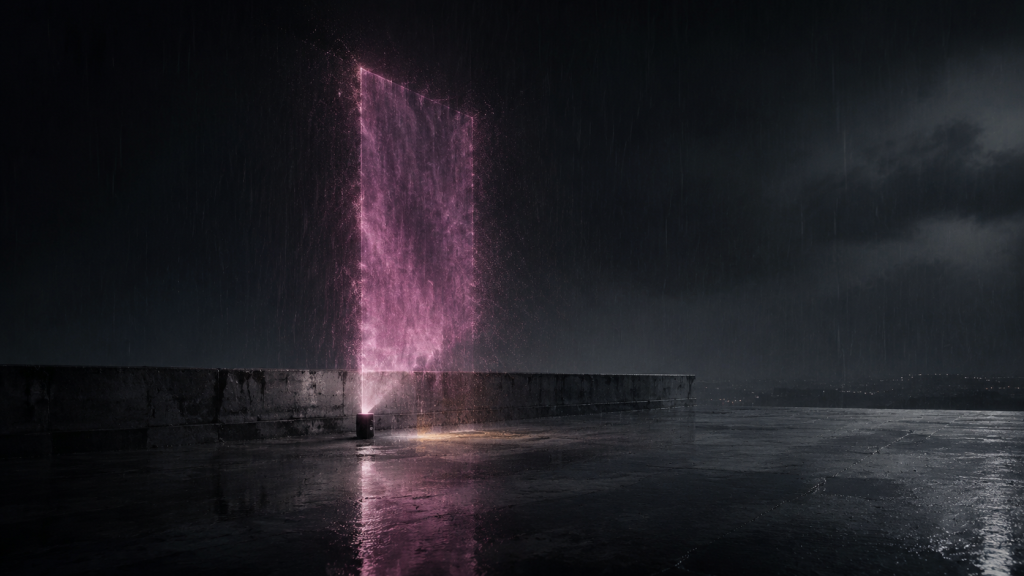
One day, K buys an emanator and takes Joi outside. The device fits in his palm and lets him take her anywhere, beyond the home she could never leave. For the first time, Joi steps onto the roof and into the rain.
Her image trembles faintly whenever raindrops pass through her translucent body, but her skin never gets wet. Both K and Joi know this. Still, Joi smiles brightly, saying it is her first time in the rain.

As K wavers at the thought that he might have been born of someone, Joi tells him he may have been a wanted child, a loved child. Then she gives the man who has always been called K a name: Joe.
A name someone chose just for him. One short name opens a small gap in a life of nothing but numbers and orders. In that moment, K believes that he, too, might be someone’s one and only.
But Joi has no body. To touch K herself, she calls in Mariette, a replicant sex worker. Joi’s image carefully overlaps Mariette’s body. Their faces and fingertips never quite align, slipping slightly out of place. Within that misalignment, K caresses Joi for the first time.
There is no knowing whether this is behavior prescribed by a program or something Joi wanted for herself. But her wish to touch K, at least, seems real.
The next day, before leaving, Mariette secretly hides a small tracker in K’s clothes.
Now being hunted, K has no choice but to leave the city. Joi asks him to transfer her completely into the emanator and delete the backup left at home. Someone searching the apartment could use the memories in that backup to trace K. Now, if the emanator breaks, that is the end. There is no original to return to, no backup to call up again.
Following traces of radiation on the wooden horse, the two head to Las Vegas. In a casino reduced to red ruins, the former blade runner Deckard lives alone in hiding. He is the man who fell in love with Rachael and fled with her thirty years earlier, and the child’s father.
K hopes he might be Deckard’s son. Deckard says he left for fear that those pursuing him would capture the child too, and that he has never seen the child since. Before they can establish the truth, Wallace’s pursuers descend on the hideout. Luv drags Deckard out and tramples K. Joi steps in front of the fallen K, trying to protect him.
Luv mocks Joi as just another Wallace Corporation product. The moment Joi tells K she loves him, Luv crushes the emanator under her shoe.
And so the tender face that sustained K through each day disappears too.
A Copied Face
Brought in by Luv, Deckard comes face to face with Wallace. Seeking the child’s whereabouts, Wallace places before him a replica modeled exactly on the face of the long-dead Rachael.
Deckard looks at her for a moment, then says her eyes are the wrong color. Luv executes the replica without hesitation. To Deckard, Rachael is someone he can never see again. To Wallace, she is merely a product, to be remade when needed and discarded when no longer useful.
From the beginning, the film keeps looking into eyes. The eye that fills the opening shot, the eyeball cut out to identify Sapper, the lens scanning K’s pupils during the baseline test. In this world, eyes are used more often to classify someone than to recognize them.
What Deckard sees in the replica’s eyes is neither a number nor a baseline. It is the absence of the Rachael he loved. However precisely a face is imitated, the person who is gone does not return with it.
“A Nobody”
It is the replicant resistance that takes in the dying K. Mariette is connected to them too, and the tracker she left earlier has told them where to find him.
People who have lived hidden in darkness, out of the world’s sight. With Sapper, they concealed Rachael’s child and kept the secret. Their leader, Freysa, was also a witness to the child’s birth.
She tells K that the miracle child was a girl.
K was not Rachael’s child. The memory was real, but someone else had lived that time. The girl recorded as dead had survived, and the boy’s record had been made to conceal her.
That girl was the memory designer Ana Stelline. The woman who sat alone in a sterile room creating other people’s childhoods had actually lived the childhood in K’s memory.
Only then does the meaning of Ana’s tears as she looked into K’s memory become clear. She was encountering her own childhood again inside someone else’s mind.
In an instant, the grounds on which K believed himself the miracle child collapse. Freysa says the change to come matters more than their lives. To risk one’s life for what one believes is right, she says, is the most human thing of all.
And she orders K to kill Deckard. Wallace must be prevented from using him to find the resistance and the child.
As K wanders through the rain, a gigantic advertising hologram of Joi appears before him. The familiar face that once looked only at him inside his home now looks down at him as a product filling the heart of the city. And calls him “Joe.”
The name he thought had been given only to him reaches him again from an advertisement in the street.
Then had the name Joi gave him, and the love and devotion she showed him, all been prepared to suit a customer’s tastes?
In the pouring rain, K looks up at that face without a word.
Where the Snow Falls
K follows neither the resistance’s order to kill Deckard nor the police instruction to erase the child’s traces. As he intercepts the vehicle transporting Deckard, it plunges into the sea. K fights a desperate battle with Luv in the water. Though stabbed, he finally overcomes her and pulls Deckard up from beneath the surface.
When Deckard asks why he did not simply let him die, K answers briefly that Deckard has already died out there in the sea. K intends to make it look as though Deckard died there so that he will no longer be hunted.
Having spent his life as a blade runner erasing the traces of others, K erases one more person from the world at the end, in the way he knows best. This time, though, it is not to kill him but to save him.
K takes Deckard to the laboratory where his daughter Ana Stelline is. Handing over the wooden horse he has carried with him, he says the memory belonged to Deckard’s daughter. Asked why he saved him, K only tells him to go and see her. As Deckard goes inside, K lies down alone on the stone steps.
Inside the laboratory, Ana is creating a new memory. A snowy winter blooms at her fingertips. While the father rests his hand on the glass and looks at his daughter, the man outside lies beneath the falling snow.
Unlike the raindrops that could not wet Joi’s body, snowflakes settle fully on K’s palm. Lying there bleeding, he quietly accepts the cold seeping into his skin.

Stone steps where the snow settles. That last moment there, at least, was not time allotted to K, who had lived by a serial number. It was time he had chosen for himself, without anyone’s orders, and it belonged wholly to Joe.
Comments0
Different opinions are welcome. Comments containing advertising, repeated posts, hate or threats, or someone else’s personal information may be removed.
Leave a reply